Behavioral Cloning Data: Human + Sim
Behavioral-cloning (BC) data for SmolVLA can come from two interchangeable sources: a human driving the arm with a gamepad (Record Training Episodes), and a scripted MoveIt expert running entirely in simulation. Both feed the same recorder and the same LeRobot dataset, so you can mix teleop demonstrations with thousands of autonomously-generated sim episodes.
The key idea: the action is the realised joint configuration
What makes one recorder serve both sources is the action convention. At every timestep the
label written to the dataset is the arm's achieved joint configuration (read from
/joint_states) plus the commanded gripper — not the controller input that produced the
motion:
Because the action is the outcome, it is identical whether a human twist-jogged the arm there
or a MoveIt plan executed it. So the data source is interchangeable, and every episode shares one
schema (observation.images.wrist_camera, observation.state, action, task) that matches the
SmolVLA checkpoint's input/output features exactly.
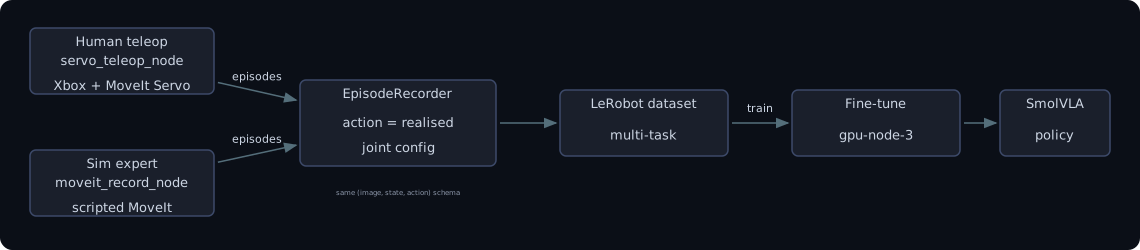
Editable diagram source: images/bc-data-architecture.c4.yaml
The shared recorder
EpisodeRecorder (ar4_teleop/episode_recorder.py) is input-agnostic. It subscribes to the
wrist camera and joint states, and exposes a tiny API any driver can call:
| method | purpose |
|---|---|
record_frame(gripper_cmd) | append one frame (realised state + action + task label) |
set_task(instruction) | change the per-frame language label → multi-task dataset |
save_episode() / discard_episode() | keep or drop the in-progress episode |
It bootstraps the dataset with LeRobotDataset.create() for a fresh corpus or
LeRobotDataset.resume() to append. Teleop and the MoveIt expert write separate
datasets (ar4_pick_place and ar4_pick_place_moveit) that share one schema — so they
stay independently versioned yet can be unioned at train time into one mixed,
multi-task corpus.
The sim expert (MoveIt-driven)
moveit_record_node is a scripted expert that drives a collision-aware pick-and-place
while the recorder captures it. The shelf is loaded into the MoveIt planning scene (parsed
from the world SDF), and placement uses a high-entry drop: lift over the shelf, descend
in front of the target tier with the gripper kept perpendicular to the facade, push into the
opening, and release so the object drops onto the plank. A single generic instruction is used
and each episode samples a random object and a random shelf, so one run yields varied
multi-task demonstrations.
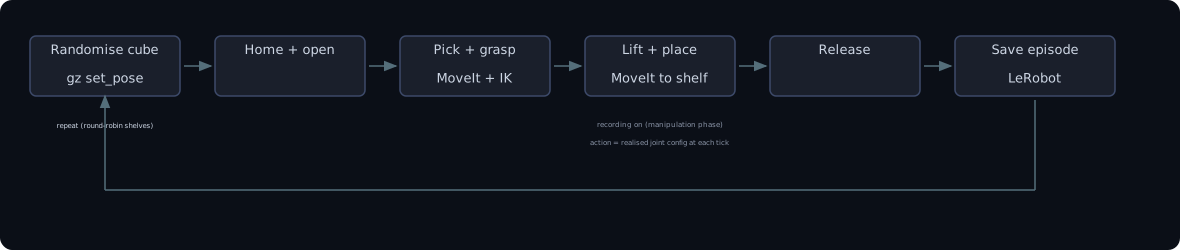
Editable diagram source: images/sim-record-loop.c4.yaml
Each episode: sample the active object → place it at a random pick pose (the rest park as distractors) → home → IK-pick top-down → grasp → verify the lift (the object must rise, else discard) → high-entry drop onto the sampled shelf → release → save. Recording is gated to the manipulation phase; missed grasps and failed plans are discarded rather than poisoning the dataset.
Declarative task spec
The whole campaign is described in ar4_teleop/config/sim_data_tasks.yaml — edit it to define
a data run with no code changes:
Each episode samples one objects entry and one shelves entry under the single
campaign.instruction. Pin a subset for testing with --object <name> / --only <shelf>.
Running it
The step-by-step commands live in
Record Training Episodes → Method B:
bring up the sim + MoveIt + the Zenoh bridge, start the decoupled recorder, run the expert
with --decoupled, then docker stop the recorder to finalize the dataset. Rehearse with
--dry-run (replays the motion, records nothing) while calibrating placement.
Runtime note — lerobot vs ROS numpy.
lerobotrequiresnumpy >= 2, while ROS 2 Jazzy (rclpy,cv_bridge) is built againstnumpy 1.26— not ABI-compatible in one Python process (cv_bridgeraisesnumpy.core.multiarray failed to importunder numpy 2). The solution is the decoupled recorder (ar4_lerobot/, thear4_rerunpattern, now built): a numpy-2 container consumes camera + joints over Zenoh (pycdr2, never importingrclpy/cv_bridge) and writes the LeRobot dataset, while the ROS-side expert signals episode boundaries over a shared file — keeping numpy 2 entirely out of the ROS runtime. The recorder callsLeRobotDataset.finalize()ondocker stop, so always stop it cleanly.
From data to a new policy
Once the episodes are recorded they flow straight into the existing training path:
- The sim episodes write to
data/datasets/ar4_pick_place_moveit/(the MoveIt-expert dataset, multi-task: top/middle/bottom), separate from the teleopar4_pick_place. - Sync the dataset to R2 and to the GPU box, then fine-tune on
gpu-node-3— see Train SmolVLA. Fine-tune from the latest checkpoint rather than from scratch, and train on the union of human + sim, top + middle + bottom, so the prompt selects the shelf instead of the policy collapsing to one behavior. - Run inference and change the prompt to pick the shelf.